Andhra Pradesh Road Sector Project (APRSP) Supported by World Bank Project
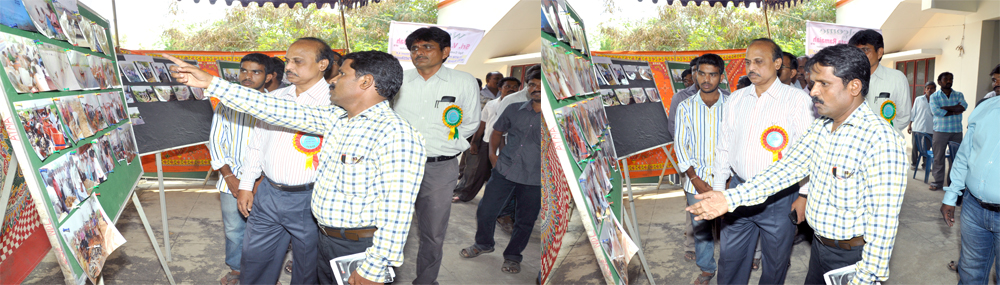
Andhra Pradesh Road Sector Project (APRSP), the Kandi – Shadnagar road (K-S Road) initiated under Phase-I projects of upgradation projects with the financial assistance of the World Bank. The Package NGO Nava Youth Association (NYA) Pattikonda, has been empanelled to facilitate and implement the Social Management Plan (SMP) activities such as Resettlement and Rehabilitation, HIV/AIDs and Road Safety awareness programmes, Tribal & Indigenous people development etc., at the road level.
The package NGO performed activities such as verification of Title Holders (THs), Non Title Holders (NTHs), Common Property Resources (CPRs) records, attending the review meetings organized by the APRDC & RISES Nodal NGO, Hyderabad, regular reporting on the progress at the package level to the APRDC, Nodal NGO, consultation on Community Property Resources (CPRs), accompanying with the World Bank team, Nodal NGO team during visits. Attending the Project Level Monitoring Committee meetings (PLMC) pursue the Land Acquisition (LA), the Resettlement and Rehabilitation (R&R) activities, organizing the awareness programmes on the Road Safety and HIV/AIDS, documenting the good practices or adopting , the information on Grievances and Case Studies.
SOCIAL MANAGEMENT PLAN
The Social Management Plan (SMP) and its components include the following:
- 1. Resettlement & Rehabilitation Action Plan (RAP)
- 2. Indigenous People Development Plan (IPDP)
- 3. HIV/AIDS Prevention and Control Plan
- 4. Road Safety Awareness Programme
1. Resettlement and Rehabilitation Action Plan:
The detailed studies undertaken in preparation of the project show road-widening and the other improvements proposed, will impact residences, business, shrines and places of worship, agricultural lands, public buildings, and infrastructure. Most of the infrastructure work planned for the project will take place within the established ROW. Before the project can be implemented, land must be acquired by Govt. wherever ownership rests with private individuals.
Resettlement will be required only where residential, commercial and residential/commercial buildings must either be fully demolished or taken to the extent that they are rendered uninhabitable. Displaced residents of these buildings will be resettled. Similarly affected business and other public and religious buildings and structures will be relocated. Rehabilitation will be required where project impacts result in lost livelihood or income. In these cases, it will be necessary to restore the economic status of affected persons to at least pre-project levels.
In most cases, the project will not require full demolition or the taking of residential or commercial structures to the extent that either resettlement or relocation will be necessary. Generally, only a narrow strip of 1-2 meters or less will be affected. Frequently, this means that only a compound wall or fence, yard, extending , or sign must be removed. In some cases, small portions of roadside dwellings and business will be taken. In all cases, however, compensation and/or assistance will be provided depending on the status and extent of the property taken.
Affected private landowners are entitled, under law, to compensation. While squatters and encroachers are not entitled to legal compensation for land they have occupied, the project will give targeted support to ensure that they are able to maintain livelihood. The project requires additional land to accommodate the proposed highway improvements. In most cases, the land required is immediately adjacent to the current carriageway and is needed for road widening, side slopes of raised formation levels, and drainage ditches. Improved junctions and intersections, new bridge approaches, and minor alignment adjustments to improve geometric alignments such as curve straightening also require additional land. New bypasses are being considered in this project.
R&R Entitlement in Brief:The project sites identified for implementation neither involve any new land acquisition nor result in physical and economic displacement of the local people. However, an R&R entitlement framework has been prepared considering any future activities that could involve land acquisition and R & R issues. The entitlement framework recognizes all affected people irrespective of their ownership of land and other assets. Besides compensation for land and other assets (at their replacement value), affected people will receive support for their relocation (if physically displaced) and economic rehabilitation (for loss of source of livelihood).
Every sub-project shall be screened for their likely adverse impacts, in the Preparatory stage itself. If in a sub-project R&R is triggered, a resettlement plan (RP) would be prepared for that specific sub project at the Planning stage itself.
This includes payment of compensation at replacement value for loss of land and other immovable assets for the proposed project interventions. Besides compensation and support in relocation process, the affected families (depending on the type and extent of loss) will get support to improve or at least restore their pre project level economic livelihood. This includes, productive assets grant, financial linkages for taking up a productive enterprise and support in skill training. In addition,to wage employment to the affected families under the project would be extended on preferential basis.
2. Indigenous Peoples Development Plan (IPDP):
The project envisages the development of indigenous people (generally referred to as Tribes in India) an important component. The IPDP, relevant to the Package, would be implemented involving local communities along the project road. The implementation framework of IPDP would be integrated with implementation of other components of SMP. IPDPs are planned and implemented in the project areas with significant tribal population
3. HIV/AIDS Prevention and Control Plan:
The plan is intended to prevent the spread of HIV/AIDS on the road corridors proposed to be developed under this project. The action plan envisages assessing the HIV/AIDS scenario, identifying factors that affect the vulnerability of different road-sector related community groups, the developing strategies to address their needs by increasing access to prevention services, promoting early diagnosis and assisting affected individuals with support services along the road corridors. The program components include behavior change communication (BCC), counseling services, condom promotion, and increasing access to quality sexually transmission infections (STI) services, voluntary counseling , testing services, also care & support and treatment services with the assistance of APSACS .
4. Road Safety Awareness Program:
The proposed activities under this program are designed to reduce the risk of accidents by raising awareness among local inhabitants and road users of the project corridors. Specific tasks of the Package NGO performed are following:
- Educated the PAPs on their rights to R&R entitlements and availability of project support.
- Established vulnerability criteria and identify them among the local communities (including potential PAPs). Design and implement methodologies to help vulnerable groups and ensure that they have access to project benefits.
- Ensured that the PAPs are given their full R&R entitlements before they are dispossessed of their assets and are displaced (physically/economically).
- Counseled and assist PAPs in their relocation and accordingly coordinate with the local authorities.
- Assisted PAPs in redressing their grievances (through the grievance redress mechanisms proposed under the project)
- Assisted the Package Unit in ensuring social responsibilities of APRDC such as, compliance with the labor laws, prohibition of child labour, gender issues, wage parity, employment to local communities etc.,
- Implemented IPSPs (where relevant to a Package) and ensured community participation in the operation and management of any community assets created under the project.
- Enhanced the level of awareness and knowledge and increase self risk perception of all stakeholders, particularly high risk groups, on HIV/AIDS and safe sexual behavior.
- Reduced the risk of spread of HIV/AIDS in the project area, worked closely with the contractors to implement the workplace intervention programs; and with the relevant agencies for various road users including truck drivers/helpers, service providers to road users, commercial sex workers, etc.
- Facilitated local communities to condoms, medical care services (for treatment of STI and HIV/AIDS).
- Developed technical capacities of agencies (other NGOs/CBOs) on promoting voluntary counseling/testing for the diagnosis of HIV. In this regard, the NGO undertook awareness program, using IEC material, on prevention of STI and HIV/AIDS in the project area
- Educated local communities and road users on the road safety measures. This would essentially include undertaking awareness campaigns on road safety measures along the project corridors.
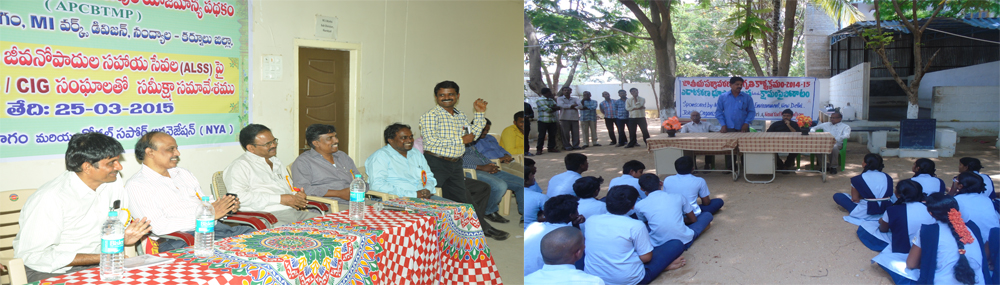
- Distributed IEC materials and educate them (including school children) on the use of safety signals and traffic movement.
Andhra Pradesh Drought Mitigation Project
Background
The Government of Andhra Pradesh has taken up Andhra Pradesh Drought Mitigation Project (APDMP) to find a longer-term solution to manage droughts and mitigate distress arising due to them. The project goal is to improve the income and strengthen the drought resilience of 165,000 farm households with an estimated project cost of Rs. 1103 crores of which Rs. 75 million USD (Rs.500 crores) is a loan from IFAD and the rest (Rs. 603 crores) is being provided by state government through convergence of MGNREGS; RKVY; RIDF (NABARD) funds. The project is operational in five most drought-prone districts in the State of Andhra Pradesh i.e. Chittoor, Ananthapur, Kurnool, Kadapa and Prakasam. The targeted farmers are small and marginal farmers including poor, landless, SC, ST those who rely on rain fed agriculture and ground water based irrigation. The project will be implemented in 315 GPs of 105 mandals in 5 districts addressing the needs of 1, 65,000 households. The project also addresses the issues of low productivity and high risk involved in farming in the drought-prone districts of southern AP. The project places concerted and coordinated effort to address the problem of repeated drought and enable farmers to increase their income in a very difficult farming environment.
Project Objectives
Component 1: Climate resilient production systems
Sub-component 1.1: Improved crop production systems
Sub-component 1.2: Improved livestock production systems
Component 1.3: Strengthened farmer organizations
Component 2: Drought proofing through NRM and water governance
Sub-component 2.1: Water governance
Sub-component 2.2: Water monitoring and conservation
Sub-component 2.3: Regeneration of common property rangeland
Component 3: Management and Lesson Learning
Project duration and cost
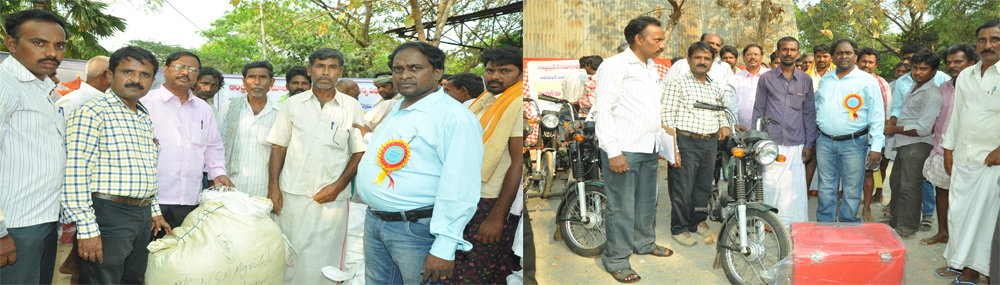
The Project duration is for a period of five-years. Total cost is estimated at USD 148.8 million and would be financed by IFAD - loan of USD 75.5 million with a contribution of USD 13.9 million from the Government of Andhra Pradesh; loan of USD 6.2 million from National Bank for Agriculture and Rural Development’s (NABARD) Rural Infrastructure Development Fund (RIDF); additional funds of USD 42 million from Mahatma Gandhi National Rural Employment Guarantee Scheme (MGNREGS); USD 2.4 million from Rashtriya Krishi Vikas Yojana (RKVY) and other schemes of the central and state governments. In addition to these contributions, USD 8.8 million is being contributed in cash and labour by beneficiaries.
Organizational Framework
At the state level, the Department of Agriculture and Cooperation (DAC) of GoAP is the nodal agency, with the implementing agencies being the Department of Agriculture and Agricultural Technology Management Agency (ATMA) at the state and district levels respectively. A Lead Technical Agency (LTA) is contracted to advise the SPMU on planning, capacity building, monitoring, documentation and IT services. To support implementation at the field level, District Facilitating Agencies are hired to: (i) carry out participatory planning at the community level; (ii) form and support FPOs and farmer interest groups and the GP water sub-committees and HUN; (iii) organize farmer field schools and other extension provision capacity building; (iv) initially operate the Climate Information Centers (CLIC) before it is handed over to an FPO; and (v) monitor implementation, including oversight on financial expenditure. NYA is one of the facilitating organizations to support implementation inPathikonda,Maddikera and Kolimigundlamandals of Kurnool.
As Facilitating Agencies Project implementation mandals is Pathikonda, Maddikera and Kolimigundla.
| S.No | Name of the Staff | Designation |
|---|---|---|
| 1 | U.Narasimhulu | Cluster Coordinator,Institution &Training Facilitator |
| 2 | T Murali | Water Management Facilitator & NRM |
| 3 | D Hussain | Agriculture Facilitator |
| 4 | J Bhanoday | Gender & Equity Enabler |
| 5 | SaipoguBabu | Water Management Facilitator & NRM |
| 6 | N Lakshmi Narayana | Water Management Facilitator & NRM |
| 7 | G.Rangamuni | Livestock Facilitator |
| 8 | S RajKumar | Account Assistant |
| 9 | S Karrenna | Data base Assistant |
Thematic wise Interventions and Progress
Agriculture:
- Soil testing, distribution of soil health cards and Soil health management (sheep penning and silt application) ZEBA
- Protective irrigation
- Row water sowing
- Distribution of Breeder seed and Foundation seed
- Formation MVKs in all clusters
- Conduct CHC studies in all clusters
- Organize FFS and Field days
NRM
Learning site wise NRM plans
- Mapping of ground water collectivization
- Soil and water conservation works through convergence
- Crop water budgeting
- Conduct PRA in All Clusters
Livestock
- Vaccination and Deworming
- Rearer Field school
- Strengthening of RLUs
- 21 Health camps conducted
- Fodder improvement
- Parasite mapping
- Identification of BYE/Vaccinators/ Service Providers
- 300 Night shelters (Poultry)
- 12 Formation of Informal Groups (SR & Poultry)
- 38 OPGK; 2 Community Gokulams and AZOLLA Demonstration
Capacity Building Activities held
- Induction training done for all staff of FA and LFA
- Orientation on preparation of Climate Resilient Production plan for All FA staff
- Orientation on NAVADHANYA process for Agriculture Facilitators and NRM facilitators
- Training on FPO modules for FPO BOD members
- Workshop on Inclusion of Gender strategy in APDMP
- Orientation Training on CMSS for LFA and FA staff
- Module development workshop on FPO modules
- Training for agriculture and NRM Facilitators on Gridlock system and on soil survey at NBSS
- Trainers of Training (ToT) on Farmer Field School for LFA staff
- Training on Farmer Field School for Agriculture, NRM Facilitators and Master Farmers FFS on kharif plantation in all Clusters of APDMP
- MVK training for FPO Subcommittee members in 10 MVKs
- ToT for agriculture and NRM Facilitators on Crop water budgeting
- Orientation Training for FPO Staff (CLic Anchors & Accountants) on APDMP project. Gender Initiatives
- Undertaken survey of women headed /single women households, landless in the project area and validated the data with the secondary sources /from GP.
- Built rapport with the women headed and single women headed families and ensured participation of women and socially marginalized (SC&ST) in project activities and more so in planning stage, situation analysis, thematic exercises etc.
- Identified the skills, interests, needs and constraints of women farmers and subsequently, the specific activities will address practical and strategic gender needs.
- Endeavoring to create gender sensitivity amongst men and household members
- Facilitating women’s involvement in entrepreneurial activities/business and ensuring the participation of landless besides supplementary livelihood activities.
- Promoting and strengthening producer groups consisting of women headed/single women and landless based on their occupation, interest and potential.
Way-Forward
The way forward is to ensure maximum impact in the three intervention Gramapanchayaths by ensuring that all habitations are involved, and Farmers Organizations providing required services through Climate Information Centers (CLIC), ensuring maximum collectivization of bore-wells, diversification of crops and land improvement and promoting water harvesting to ensure that farmers and especially vulnerable sections such as women and backward castes are equipped to deal with effects of drought.
Particulars of the Nava Youth Association Projects Executed from 2005 to Till Date
|
Sl No |
Name of the Project |
No of Beneficiaries |
Project Cost |
Project Started |
Project Completed |
Fund Supported |
|---|---|---|---|---|---|---|
|
1 |
Rural Bridge Course School |
180 Children |
3.52 Lakhs |
2005 |
2007 |
DPEP |
|
2 |
MathaSisusamrakshana (Emergency Transport Van) |
1200 Cases |
3.84 Lakhs |
2005 |
2007 |
Dept. of Health & Family Welfare (NRHM ) |
|
3 |
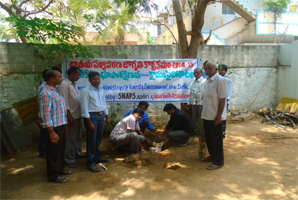
Andhra Pradesh Community Based tank Management Project (APCBTMP) |
Phase – I, II & NSO |
61.00 Lakhs |
2007 |
2015 |
Minor Irrigation Department. ( World Bank) |
|
4 |
Ground Water Awareness camps |
200 Farmers |
0.20 Lakhs |
2009 |
2009 |
Ground Water Department |
|
5 |
Mobile Medical Unit (MMU) |
42000 Out Patient |
82.00 Lakhs |
2005 |
2009 |
Dept. of Health & Family Welfare (NRHM ) |
|
6 |
Agriculture Training |
100 |
0.15 Lakhs |
2009 |
2009 |
Bio-Tech Foundation |
|
7 |
NREGS Internal Social Audit |
200 Nos. |
0.85 Lakhs |
2008 |
2008 |
DWMA |
|
8 |
Telagana Road sector Project |
145 Families |
40.00 |
2009 |
2017 |
R&B Dept. (under World Bank) |
|
9 |
Saree Rolling Program |
60 |
0.60 Lakhs |
2009 |
2009 |
NABARD |
|
10 |
Farmer Clubs |
35 |
3.30 Lakhs |
2011 |
2012 |
NABARD |
|
11 |
Beautification Course |
60 |
0.60 Lakhs |
2011 |
2011 |
NABARD |
|
12 |
Tribal Development Fund |
574 |
285.00 Lakhs |
2012 |
2015 |
NABARD |
|
13 |
Training on School Management committees |
1654 |
2.00 Lakhs |
2012 |
2012 |
Rajiv Vidya Mission |
|
14 |
Finance Literacy Program |
1250 |
5.00 Lakhs |
2015 |
2015 |
NABARD |
|
15 |
Water Campain Programme |
50 Villages |
2.00 Lakhs |
2017 |
2017 |
NABARD |
|
16 |
Conducting of training to newly formed Water User Associations (WUAs) |
642 |
6.00 Lakhs |
2016 |
2016 |
Water Resources Dept. of AP(APCBTMP) |
17 |
CSR Activities |
14 villages |
155.00 Lakh |
2017 |
Ongoing |
SUZLON&CLP |
18 |
APDMP |
9 Villages |
60.39 lakh Per 1 Year |
2017 |
ongoing |
IFAD Funding |
|
19 |
AP Road Sector Project |
31 Villages |
35.00 Lakhs |
2018 |
Ongoing |
R&B Department under World Bank Assistance |
20 |
FPO-Fisheries |
6 villages |
23 lakhs |
2019 |
Ongoing |
NABARD |